Napa Valley Tour Packages & All-Inclusive Options
A Napa package can fold the driving, the tastings and lunch into one price, or it can be a transport ticket with everything else still to pay. Here is how to tell them apart and price the value.
Short answer
A Napa Valley tour package bundles the parts of a wine day, transport with a driver, winery visits, and sometimes tastings and lunch, into one booking. 'All-inclusive' is the version that also covers tasting fees and a meal, so there is no running tab. Most standard packages still leave fees, lunch and tips as extras, so read the inclusions line and do the value math before you book.
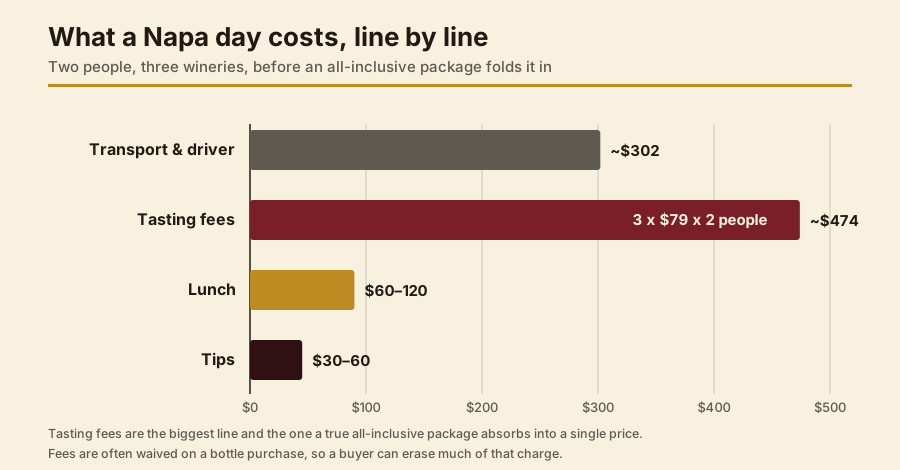
Two Napa "packages" at the same headline price can be very different days. One is a full-day tour with a driver, three seated tastings and lunch all inside the ticket. The other is a transport seat that gets you to the wineries and leaves the roughly $79-a-head tasting fees, the meal and the tips for you to settle on the spot. Add three wineries for two people and that second package quietly costs a couple hundred dollars more than its sticker by the end of the day. The word on the listing does not tell you which one you are buying. The inclusions line does.
Napa is the kind of place where the extras stack up fast, so a package that bundles them is worth real money, and one that does not is worth knowing about before you go. This guide separates what "all-inclusive" actually covers from what standard packages leave out, runs the value math both ways, and lines up the package types so you can match one to your trip.
What is a Napa Valley tour package?
A Napa Valley tour package is a single booking that bundles the moving parts of a wine day: transport with a driver, a set of winery visits, and depending on the package, tastings, lunch and pickup. Packages range from budget large-group bus tours through small-group and private options to combined Napa and Sonoma day trips from San Francisco. The point of a package is to hand off the logistics of a day that is otherwise all reservations, routing and a designated driver.
The reason packages exist at all is Napa's structure. The valley floor runs only about 30 miles top to bottom along Highway 29 and the Silverado Trail, the estates sit miles apart with no sidewalks between them, and most require a booked, seated tasting. A package collapses all of that, the driving, the reservations, the route, into one purchase. What separates a good-value package from a thin one is how much of the day's real cost it actually covers, which is where "all-inclusive" comes in.
Before the details, here are the three formats most visitors compare when they shop for a package, from a bundled private day to the value small-group classic.
What does "all-inclusive" actually cover in Napa?
An all-inclusive Napa package folds the tasting fees and a meal into the ticket price, on top of the transport and driver, so you pay one number and carry no running tab through the day. That usually means round-trip transport or door pickup, a driver and guide, tastings at each winery included rather than paid at the door, and lunch. What even all-inclusive rarely covers is the driver's gratuity and any bottles you buy to take home.
The value of all-inclusive is certainty. Tasting fees are the line that scales fastest in Napa, averaging around $79 a person per winery, so a package that absorbs them turns the most variable cost of the day into a fixed one. For a group that plans to visit three wineries, that is the difference between a predictable price and a bill that grows at every stop.
| An all-inclusive package usually covers | It usually does not cover |
|---|---|
| Transport and a dedicated driver or guide | Driver gratuity, typically 18 to 20 percent |
| Winery visits with tastings included | Bottles you buy to take home |
| Lunch, a picnic or a sit-down | Extra add-ons like a balloon flight |
| Door-to-door pickup on private packages | Reserve or premium tastings beyond the set flights |
| The reservations, arranged for you | Personal spending in town |
The all-inclusive private package is the clearest version of this model, built so the whole day sits under one price.
The All-Inclusive Private Tour is designed for travelers who want the driving, the tastings and the meal covered in a single booking, with no fees to settle at each winery. It suits couples and small groups who would rather not track a tab, and the current price sits on the operator's listing. If you prefer to pay for the vehicle and handle fees separately, our guide to private Napa tours and custom itineraries compares the à la carte private route against a bundled one.
What is usually not included, even in a "package"?
Most standard Napa packages are not all-inclusive. A budget or mid-tier package commonly covers transport and the driver but leaves the tasting fees, lunch and tips for you to pay separately. Some include a set number of tastings but not lunch; some include neither. The single most important thing to read before booking is the inclusions line, because a low headline price often means the fees are still coming.
This is where visitors get caught. A package advertised at an attractive rate can be a transport ticket in disguise, and the real day costs far more once the extras land. Tasting fees alone, at around $79 a person for three wineries, add close to $475 for a couple. Add lunch and tips and the "cheap" package can out-cost an all-inclusive one that looked pricier on the listing.
| Package tier | Usually includes | Usually leaves you to pay |
|---|---|---|
| Budget large-group bus | Transport, driver, sometimes 3 tastings | Lunch, tips, extra tastings |
| Standard small-group | Transport, driver, often tastings and lunch | Tips, bottles |
| Private (à la carte) | Vehicle, driver, custom route | Tasting fees, lunch, gratuity |
| All-inclusive private | Transport, driver, tastings, lunch | Gratuity, bottles |
The lesson is simple: compare packages on what they include, not on the headline number. A slightly higher all-inclusive price can be the better deal once the extras on a "cheaper" package are counted. Our blog on what a Napa wine tour really costs breaks every one of those lines down.
How much do Napa Valley tour packages cost?
Package prices span a wide range by type. Budget large-group bus tours from San Francisco start around $119 to $157 per person, often with three tastings included. Small-group packages run roughly $148 to $199 per person, and the classic Napa full-day sits around $151. Private packages start near $399 per person or run $600 to $1,200 and up per vehicle. On top of any package that is not all-inclusive, add tasting fees, lunch and tips.
Where a package lands depends on group size, region covered, and how much is bundled. The per-person cost of a private package drops as the vehicle fills, while a per-person bus tour stays flat. The table below gives the current market ranges; the live price for any specific tour sits on its own listing.
| Package type | Typical price | Pricing basis | Extras to expect |
|---|---|---|---|
| Budget large-group (from SF) | About $119 to $157 pp | Per person | Lunch, tips, some tastings |
| Small-group classic | Around $151 pp | Per person | Often none beyond tips |
| Mid-group from SF | About $148 to $199 pp | Per person | Higher fees, lunch |
| Private (à la carte) | From about $399 pp, or $600 to $1,200+ per vehicle | Per group | Fees, lunch, gratuity |
| All-inclusive private | On the listing | Per group | Gratuity, bottles |
The value benchmark most people price against is the small-group classic, because it bundles the hardest parts of a Napa day at a fixed per-person rate.
The Napa Valley Small-Group Winery Tour is rated 4.9 across more than 1,000 reviews and usually starts around $151 per person, with a guide driving, three family wineries booked ahead, and a picnic lunch included. Because those inclusions are already inside the price, it behaves like a near-all-inclusive package at a small-group rate, which is a large part of why it is the format so many first Napa days start with.
All-inclusive or pay-as-you-go: which is better value?
All-inclusive wins on certainty and often on total cost once you count the extras. Pay-as-you-go can win if you plan to visit only one or two wineries, expect to buy enough wine that fee waivers cancel the tastings, or want the freedom to change the day on the fly. Run the numbers for your specific group: total the transport, the per-person fees at your planned number of wineries, lunch and tips, then set that against an all-inclusive price. For most three-winery days, the bundle comes out ahead.
The math hinges on how many wineries you plan and whether you will buy bottles. Napa fees are frequently waived or credited toward a bottle purchase, so a buyer who leaves with wine may erase the tastings anyway. A taster who buys nothing pays every fee in full, which is exactly the case where an all-inclusive package saves the most. Here is a worked example for two people over three wineries.
| Line item | Pay-as-you-go (2 people, 3 wineries) | All-inclusive package |
|---|---|---|
| Transport and driver | Included in tour | Included |
| Tasting fees | About $474 (3 x $79 x 2) | Included |
| Lunch | About $60 to $120 | Included |
| Tips at tasting rooms | About $30 to $60 | Handled or minimal |
| Where the total lands | Sticker price plus $500 or more | One fixed number |
The point is not that all-inclusive is always cheaper, it is that pay-as-you-go rarely costs what its sticker says. Once the fees are on the table, the "expensive" bundled package and the "cheap" transport ticket often meet in the middle, and the bundle removes the arithmetic.
What types of Napa tour packages are there?
Five main types cover most needs: budget large-group bus tours, value small-group day tours, fully private packages, combined Napa and Sonoma day trips from San Francisco, and the Wine Train as a rail-based package. They differ on price, group size, how much is bundled, and whether they start in Napa or in the city. Your starting point and your appetite for planning usually pick the type for you.
Each type answers a different question. Budget bus tours are the cheapest way in from San Francisco and the most social. Small-group tours are the value sweet spot for a bundled Napa day. Private packages buy control and door-to-door service. Combined regional day trips let you sample two wine countries at once, and the Wine Train packages a scenic lunch on rails. A private package is the pick when your group wants its own vehicle and a custom route.
The Private SUV Wine Tour, rated 4.9 across 260 reviews, prices by the group and shapes the itinerary around your list, with hotel pickup and a dedicated driver. As a package it is the à la carte private option: the vehicle and driver are covered, while fees and lunch stay separate unless you upgrade to an all-inclusive build. The best way to tour Napa Valley weighs these formats against the trolley and the train.
What about Napa tour packages from San Francisco?
Day-trip packages from San Francisco bundle the round-trip drive with the wine day, which matters because the city of Napa sits about 47 miles from downtown SF, roughly an hour to an hour and twenty in normal traffic and longer at Bay Area peaks. Most depart between 8 and 9 a.m. to reach wineries near their 10 a.m. opening and return in the evening, running 8 to 10 hours total. Many of these are combined Napa and Sonoma trips, which should be recognized as visiting two separate regions.
The appeal of a from-SF package is that it removes the drive planning entirely, along with the designated-driver problem, since California's limit is 0.08 percent blood alcohol under Vehicle Code Section 23152 and a day of tastings crosses it easily. The trade-off is time on the road and, on combined trips, less depth in each region. Napa runs more formal and appointment-heavy with higher average fees; Sonoma sits to the west, more casual and walk-in-friendly with lower average fees.
The San Francisco to Napa and Sonoma Wine Tour, rated 4.3 across more than 4,500 reviews, is the high-volume combined day trip that handles the round-trip drive and samples both regions. It is explicitly a Napa and Sonoma package, not a Napa-only one, which is the honest way to read any two-region day. For the full logistics of getting up from the city, our guide to Napa wine tours from San Francisco covers routes, timing and half-day versus full-day options.
How long are the packages, and how many wineries do they include?
Full-day packages run about 8 to 10 hours and typically include two to four winery visits; from-San Francisco trips sit at the longer end because of the drive. Half-day packages trim the ambition to one or two wineries and skip much of the road time. Almost no package fits more than four wineries, because each seated tasting takes 90 to 120 minutes and palate fatigue is real. Three well-paced stops is the standard a good package is built around.
Length and winery count go together. A package advertising five or six wineries in a day is usually overselling, since the tastings themselves cap the number. What a well-designed package does is pace three stops with a real lunch, not race through a checklist. The table sets out the common shapes.
| Package length | Wineries | Typical shape |
|---|---|---|
| Half-day | 1 to 2 | Afternoon, less driving, shorter reach |
| Full-day (Napa start) | 3 to 4 | The standard bundled wine day |
| Full-day from SF | 2 to 3 | Longer, includes the round-trip drive |
| Combined Napa and Sonoma | 2 to 4 | Two regions, more road, less depth each |
How do you choose the right Napa package?
Match the package to your starting point, group size and how much you want handled. Start in Napa and want value: a small-group classic. Want one price with nothing to settle: an all-inclusive private package. Traveling as five to seven and wanting your own route: an à la carte private package, which splits well across the vehicle. Coming from San Francisco: a from-SF day trip, single-region for depth or Napa and Sonoma for variety. Watching the budget from the city: a large-group bus tour.
There is no single best package, only the best fit for your day. The deciding questions are where you begin, how many are in your party, and whether you would rather pay one bundled price or keep the day flexible and settle as you go. When you book Napa Valley Wine Tours, start from those answers and let them point you at the type, then check the inclusions line so the price you see is the price you pay.
| If you want... | Choose | Why |
|---|---|---|
| The best bundled value from Napa | Small-group classic | Fixed price, tastings and lunch usually in |
| One price, zero running tab | All-inclusive private | Fees and meal absorbed |
| A custom route for a full car | Private à la carte | Per-vehicle cost splits well |
| To skip the drive from SF | From-SF day trip | Round-trip transport handled |
| Two regions in a day | Napa and Sonoma combo | Variety over single-region depth |
Data from the Visit Napa Valley 2025 economic study on visitnapavalley.com shows overnight visitors drive the vast majority of spending, which is the quiet argument for treating a package as part of a longer stay rather than a one-off race up from the city. If a package turns into two nights, a value base like Hotel Napa Valley keeps the lodging line reasonable while still putting you minutes from downtown. However you build it, the honest test of a package is the same: read what it includes, add what it does not, and pick the one whose true total, not its sticker, fits your trip.
Hotel Napa Valley · Napa, value base Check rates ›